

The “official version”
What is the official version of the collapse of Building 7?
An important premise: it is not an “official version.” This expression is inappropriate because it suggests a government narrative to be accepted without evidence. Instead, there is a technical reconstruction of the WTC7 collapse, titled NIST NCSTAR 1A - Final Report on the Collapse of World Trade Center Building 7 and available here, which was carried out by independent specialists on the basis of firefighter testimony and surveys, photographic and video evidence, and sophisticated computer simulations of the physics of a burning building. No expert in the field, from any country in the world, disputes it in a documented manner.
The collapse mechanism of WTC7 is defined as progressive collapse and is well known among professionals: it appears anomalous to laypeople because WTC7 was the first tall building to undergo a progressive collapse caused by fire (the second was the Plasco Building in Tehran in 2017).
In summary, WTC7 was struck by debris from the collapse of the North Tower, which ignited fires that burned for hours without being extinguished (there was no water supply). The heat weakened the entirely steel structure and broke some joints connecting the floors to the central cluster of load-bearing columns. Some floors collapsed internally, causing one particular column, number 79 at the northeast inner corner, which carried a very heavy structural load, to lose lateral support across several stories and buckle, pulling the floors down with it. The other columns attempted to bear the extraordinary load, but being weakened, they also buckled, and the structure began to collapse. The collapse occurred at approximately 5:20 PM on September 11, 2001.
In detail, WTC7 was struck by debris from the North Tower, which was 410 meters tall and located about 110 meters away. The burning debris ignited fires on at least ten floors along the south and west sides of WTC7. The fires were fueled by the building’s contents (furniture, paper, carpeting), as happens in any office or residential fire.
On floors 7 through 9 and 11 through 13, these fires burned uncontrolled because the fire suppression system had no water: the supply lines had been damaged by the collapse of the Twin Towers.
The fires spread toward the northeast side of the building (where the collapse began). The vertical columns did not reach temperatures above 300 °C, but the long horizontal steel beams on the east side of WTC7 reached 600 °C on several floors: a temperature insufficient to melt them, but sufficient to weaken them and cause significant thermal expansion, which was one of the key factors in the building’s collapse.
On the 13th floor, thermal expansion and heat broke one of the joints connecting one of these long horizontal beams to one of the primary central columns, number 79, and to one of the façade columns, number 44.
The fall of the horizontal beam caused the local collapse of the 13th-floor slab, triggering a chain reaction of floor collapses down to the fifth floor. Column 79 thus lost east-west lateral support across a height of nine stories and consequently buckled, removing support for all the floors above it, which then collapsed.
The figure below shows a horizontal section of a typical WTC7 floor, with the arrangement of the horizontal structural elements. The numbers identify the columns. The initiating column, number 79 at the northeast inner corner, is at the bottom left.
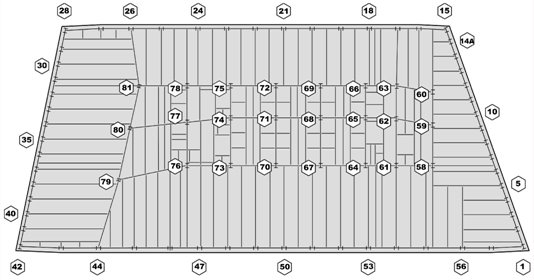
The collapse then propagated upward to the roof and subsequently involved the other two columns (80 and 81). The collapse then spread from east to west, progressively overloading the other structural columns in sequence. Finally, the entire facade collapsed.
Before the collapse
Why did a witness, Barry Jennings, say that he heard loud explosions while he was inside the building?
He heard them in the morning, but the building collapsed in the late afternoon: whatever their origin, they certainly did not cause the collapse of the building.
Even if we were to hypothesize that those explosions were part of some strange step-by-step demolition of the WTC7 structure, another major series of explosions would then have been necessary just before the collapse itself in order to trigger it, but none of the recordings of the collapse contain the sound of such explosions.
A burning building can produce loud bangs for many other reasons: local structural failures, deflagrations of flammable materials, explosions of fuel tanks in cars and trucks in parking areas, even the bursting of cathode-ray tube monitors from the many computers present in an office building. WTC7 also contained diesel fuel tanks for backup generators on several floors.
Isn’t it strange that this witness, Barry Jennings, died under unclear circumstances shortly after making those statements?
He did not die under unclear circumstances at all, contrary to what some conspiracy theorists insinuate. He died for entirely ordinary reasons that his family, tired of the obsessive attention from conspiracy theory supporters, do not wish to share publicly.
Anyone suggesting that he was “eliminated” because he had said too much should explain why the person who shared the experience with him in WTC7 and also described it to the BBC, Mike Hess, is still alive.
What is that spot visible on the façade of WTC7 in a video? Is it a puff from an explosion?
No, it is the mobile platform used for cleaning the façade. It looks like a spot because the video is grainy, but other photographs show it clearly (details).
The fire
Is it true that the smoke seen in the photographs does not come from WTC7, but from the adjacent WTC6, and that there is no evidence of major fires in WTC7?
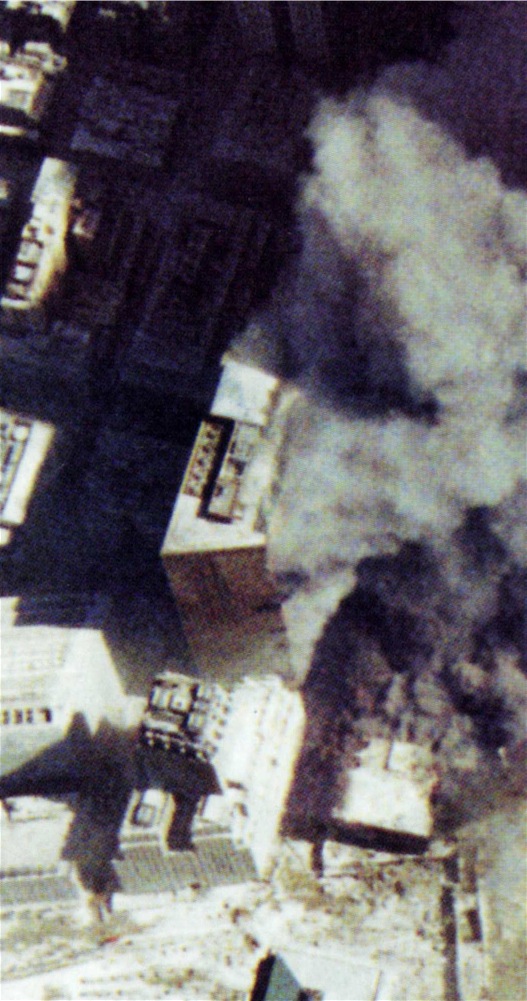
It is enough to look at these images to realize that it is not true that the smoke came from adjacent buildings. The smoke clearly originates from WTC7, and there definitely were fires burning inside it. This is confirmed both by firefighters and by the video footage shot by photojournalist Steve Spak.


How is it possible that debris from the Twin Towers ignited fires in WTC7?
At first glance it may seem strange that debris from a collapse could start fires, but it should be noted that the same thing also happened to other buildings about which supporters of alternative theories have expressed no suspicions.
In fact, WTC 4, 5, and 6 — the relatively low-rise buildings (8 to 9 stories tall) located at the base of the Towers — were also devastated by fire after the Towers collapsed, even though they had not been struck by airplanes, just like WTC7. They began burning after being hit and damaged by debris from the Twin Towers, again just like WTC7.
Warning signs of collapse
Why did CNN announce the collapse before it happened?
CNN journalist Aaron Brown, reporting from New York, said at 4:10 PM local time that he was receiving reports that the building "is on fire and has either collapsed or is collapsing". These were therefore very vague reports, and before 9/11 the building was not particularly famous, so the journalist did not know how to identify it in the Manhattan skyline behind him. The reports were entirely logical: firefighters had known since the early afternoon that the collapse was inevitable, and the news reached journalists (details).
Why did the BBC announce the collapse before it happened, even while showing WTC7 on screen?
The BBC explained that journalist Jane Standley, who announced it live on TV from New York, was simply reporting in good faith incorrect information she had received from Reuters. Reports about the imminent collapse of WTC7 had been circulating for hours: someone was simply too hasty, that's all.
Reuters shortly afterward withdrew the incorrect report, one of many that are often issued during dramatic events such as 9/11, but by then the announcement had already been made. Jane Standley had only recently arrived in New York and did not know that the building visible in the background behind her was WTC7; besides, before 9/11 WTC7 was just one of many little-known skyscrapers in New York (and it was known as the Salomon Building, not as WTC7).
Alternatively, one could prefer to believe that the BBC was part of the conspiracy, because it had been informed in advance by the conspirators about what was supposed to happen and how it should be announced, but mistakenly read the line from the script too early (details; details).
Why was the connection interrupted immediately after the BBC journalist mistakenly announced the collapse of WTC7 before it actually collapsed?
The BBC explained that the timer for the satellite transmission was scheduled to cut off at exactly 5:15 PM, and it did so as expected, interrupting the connection (details).
Why did the recording of the premature announcement of WTC7’s collapse disappear from the BBC archives?
It did not disappear: it had been archived in the section dedicated to 2002 instead of the one for 2001. Archivists recovered it long ago (details).
The Collapse
Why did WTC7 collapse without being hit by an airplane?
It was not hit by an airplane, certainly, but it absolutely did not collapse for no reason:
- it was heavily struck by debris from the North Tower;
- it had a twenty-story gash in the facade facing the towers, documented by firefighters and live TV broadcasts (image below);
- one corner was damaged across ten stories;
- it had extensive internal fires visible on the north, east, and south facades;
- an enormous amount of smoke was coming out of its south facade;
- it was left burning for nearly seven hours without any intervention.
Under those conditions, is it really so strange that it collapsed?
 |
| WTC5 on fire. From the FEMA report (2002), chapter 4, page 13. |
 |
| The damaged facade of WTC7 facing the Towers. |
How come WTC7 collapsed unexpectedly?
It did not collapse unexpectedly: the collapse had been anticipated for hours. Rescue workers expected it, which is why the building was evacuated and nobody died in its collapse. Firefighters noticed shortly after noon that WTC7 was leaning and creaking, and they cleared the area.
For example, New York Fire Department deputy chief Peter Hayden explained that specialists set up surveying devices (called transits or theodolites) to monitor movement in the building: "We were concerned about the possibility of the building collapsing" he said "and we discussed it with an engineer in particular... we asked him whether, by letting it burn, it was likely to collapse and how long it would take. It turned out he was pretty much right... he said, 'In the condition it’s in now, you’ve got about five hours'".
Some firefighters interviewed by us, such as Lenny Curcio, Frank Papalia or Larry Monachelli, also confirmed that the building was severely damaged and had been cordoned off. A video shows firefighter Miller stating that the collapse was expected and inevitable.
The BBC and CNN also announced the impending collapse beforehand (details).
Why does the collapse of WTC7 look so much like a controlled demolition?
Any building collapse has aspects in common with a controlled demolition. A controlled demolition is, after all, a collapse — the difference is that it is deliberately triggered with explosives instead of another cause. But one must prove that explosives were present, and explosives leave traces.
Those who claim it was a controlled demolition must answer these questions: where did the detonators and miles of wiring go? Where are the chemical and physical traces of explosions? Why did none of the many people who worked in WTC7 notice anything?
Why do puffs come out of the building during the collapse, just like in a controlled demolition?
In real controlled demolitions, those puffs appear before the collapse begins, not during it.
Moreover, if the building is already collapsing, what would be the point of additional explosions? And if this were supposedly a conspiracy, why would the organizers be careless enough to create revealing puffs?
In reality, the puffs were caused by smoke and dust being forced outward by compressed air inside the collapsing structure. Unsurprisingly, the images show that they came from areas where windows had already been broken.
Why did WTC7 collapse if the fires were small?
Does the fire shown below look small to you? Exactly.

But how is it possible for a large skyscraper to collapse from a simple fire? It had never happened before.
First of all, it was not a simple fire, considering that it had been struck by debris from a colossal building over 400 meters tall standing in front of it. In any case, there is always a first time for everything, and the fact that a skyscraper can collapse in the event of a large uncontrolled fire is well known to engineers and firefighters: it is part of the so-called accepted risk. That is precisely why fire protection systems and safeguards are installed.
In fact, there are precedents of other skyscrapers on fire that risked collapsing solely because of fire. They did not collapse because firefighters managed to save them. At WTC7, however, firefighters could do nothing: they had to let it burn.
Furthermore, while engineers design buildings to withstand fires originating inside the structure, the fires at WTC7 started in a completely abnormal way, namely from the outside: from the burning debris of the North Tower.
In other words: the WTC7 fire had extraordinary consequences because it was an extraordinary fire, but it was not at all anomalous to professionals in the field.
Why was the collapse so vertical and symmetrical?
In reality, it was not nearly as vertical as it appears. This impression comes from the fact that the footage usually shown frames the north facade head-on: this makes it impossible to notice that WTC7 tilted diagonally toward the south.
Some lesser-known videos and the distribution of debris document that the collapse was not vertical and symmetrical at all: debris from the north facade was found lying on top of the rest of the rubble pile, something possible only with a tilted collapse. And the debris damaged nearby buildings (Fiterman Hall and Verizon Building).
The following images show that during the collapse WTC7 tilted and shifted laterally.
 |
| A sinistra, la Fiterman Hall; la facciata del WTC7 solitamente visibile nelle immagini del crollo stava a destra. |
 |
| Grandi frammenti di facciata coprono la catasta di macerie del WTC7. |
Why was the collapse too fast?
First of all, one would need to define what is meant by “too fast”, but in reality no footage of the collapse is complete, because the base of WTC7 is obscured by the dust cloud from the collapse and by the surrounding buildings, so it is impossible to make a total timing measurement.
Furthermore, conspiracy theorists always cut out the long initial phase, during which the rooftop structures fail, then there is a pause, and only afterward does the rest of the building collapse. Have you ever seen a controlled demolition pause halfway through? The total duration was at least 13 seconds, as also confirmed by seismic data.
According to the NIST analysis (NCSTAR 1A, p. 45), WTC7 fell for 18 floors, or 73.8 meters, in about 5.4 seconds. If it had collapsed in free fall, it would have taken 3.9 seconds: therefore this phase of the collapse lasted 40% longer than free fall.
Why was the collapse so precise, without damaging surrounding buildings, just like in a controlled demolition?
It was not like that at all. The debris from WTC7 crashed into the adjacent Fiterman Hall building (the white building in the photo below), damaging it so badly that it had to be demolished, and large gashes were torn into the Verizon Building, whose repair cost over one billion dollars (details; more details).
 |
| Above, Fiterman Hall struck by debris from WTC7 (in the center of the image). |
NIST says that the first 30 meters of the collapse occurred at free-fall acceleration. How can a fire cause a collapse that fast? Isn’t a free-fall collapse evidence that all supports failed simultaneously, meaning controlled demolition?
First of all, the NIST NCSTAR 1A report from November 2008, on page 45, does not say that the first 30 meters occurred in free fall, but rather that this happened during a second phase of the collapse. It also states that during the first phase the collapse was much slower than free fall: about 2.2 meters in 1.75 seconds, compared to about 15 meters for a free fall lasting the same amount of time. If this had been a controlled demolition, this initial slow phase would not have existed: the instantaneous failure of all supports would have produced an immediate free-fall collapse.
According to NIST, the second phase of the collapse occurred at free-fall speed, but only for 2.25 seconds, during which the structure descended vertically by 32 meters. NIST explains this phase by stating that the columns that had already failed provided negligible support.
During the third phase of the collapse, the descent again became slower than free fall because the upper portion of the north façade (used as the reference point for these estimates) encountered greater resistance from the already-collapsed structure beneath it.
This collapse behavior, therefore, does not necessarily imply the use of controlled demolition techniques. The initial slow phase is instead compatible with a rapid progressive collapse, in which a main load-bearing element, weakened by fire, fails, forcing nearby structural elements to bear the load previously carried by the failed element. If these nearby structural elements are also weakened by heat, they fail in turn, triggering a chain reaction of collapses that can propagate very rapidly while still producing a relatively slow overall collapse. Once all the supports have failed, a substantially free-fall descent begins.
In other words, the brief period of free fall does not demonstrate the use of explosives at all, but can instead be explained in a non-conspiratorial way that is consistent with the other known facts (for example, firefighters’ testimony). (details)
The events afterward
Why did Larry Silverstein, the owner of WTC7, admit live on TV that he ordered the building to be demolished? He said "pull it", which in jargon means "demolish with explosives".
This is a very common question, but it contains quite a mix of errors:
- Silverstein was not the owner, but the leaseholder;
- the controversial phrase was not spoken live on TV, but in a prerecorded documentary, America Rebuilds, so Silverstein could have had it edited out if it had been a slip-up;
- Silverstein said "pull it" meaning "withdraw it", referring to the group of firefighters he was talking about, and he clarified this years ago;
- it is not true that in demolition jargon "pull" means "demolish with explosives". It means "bring down by pulling with cables", which would be ridiculously impossible for a 174-meter skyscraper, so the meaning must be another one: namely the one explained by Silverstein, meaning to withdraw;
- in the sentence in question, Silverstein said that he did not make the decision himself, but that the firefighters made it ("they made that decision to pull"). So according to the conspiracy interpretation, it would have been the firefighters who carried out the secret demolition: in other words, conspiracy theorists are accusing firefighters of being active accomplices in the conspiracy.
Moreover, why would Silverstein casually confess on television to a demolition that was supposedly meant to remain top secret?
The exact quote is as follows: "I remember getting a call from the fire department commander, telling me that they were not sure they were gonna be able to contain the fire, and I said, 'We've had such terrible loss of life, maybe the smartest thing to do is pull it.' And they made that decision to pull and then we watched the building collapse." Notice the "they", which attributes the decision to the firefighters (details).
WTC7 housed a CIA office: was it destroyed to make sensitive documents disappear?
It seems unlikely that the best way to make documents disappear would be to blow up an entire building, with the risk that papers might fly outside, when a normal paper shredder could discreetly do the job.
In reality, the CIA did indeed have an office in WTC7, as did many other companies, but it had to send a special team to search through the ruins for classified documents and intelligence reports, to prevent them from falling into the wrong hands. Exactly the opposite of what conspiracy theorists claim.
Why does the 9/11 Commission Report not mention WTC7 at all?
In reality, it mentions it several times. WTC7 is mentioned on pages 284, 293, 302, and 305 (as "7 WTC"). The Commission Report does not mention the collapse of WTC7, but then again it also does not mention the collapse of St. Nicholas Greek Orthodox Church, nor the destruction of WTC3 (the large 22-story Marriott hotel that stood next to the Twin Towers) (details).
Why were none of the designers of WTC7 indicted?
To indict them, it would be necessary to prove that they violated fire safety building regulations. In ten years of investigations and insurance reimbursement trials, no such violation emerged.
It should also be remembered that the WTC7 fire was highly unusual: it was not fought in any way (there was no water available to extinguish it because the pipelines had been destroyed by the collapse of the Twin Towers), and it was left to burn uncontrolled for about seven hours.

Nessun commento:
Posta un commento